
When I got sober, I thought the hard part was over.
I thought if I could stop using substances, everything else would start falling into place. I imagined I would finally feel peaceful. I thought I would have more energy, less anxiety, and a lot fewer problems.
That wasn’t my experience.
The substances were gone, but I still felt exhausted. I was always waiting for something bad to happen. If my phone rang unexpectedly, my stomach tightened. If life was going smoothly, I found myself wondering how long it would last before something fell apart.
For a long time, I thought something was wrong with me.
I had worked so hard to get sober. Why didn’t I feel better?
What I eventually learned was that getting sober and healing are not the same thing.
Getting sober was one of the hardest things I have ever done, but it didn’t automatically undo years of living in chaos, stress, fear, unhealthy relationships, and survival mode. My life was changing, but my mind and body were still acting like they needed to stay on high alert.
Once I understood that, so many things started making sense.
If you’ve been in recovery for a while and you’re wondering why you still feel exhausted, anxious, overwhelmed, disconnected, or unable to relax, I want you to know you’re not alone.
You may not have a recovery problem.
You may have a survival mode problem.
And that’s exactly what we’re going to talk about.
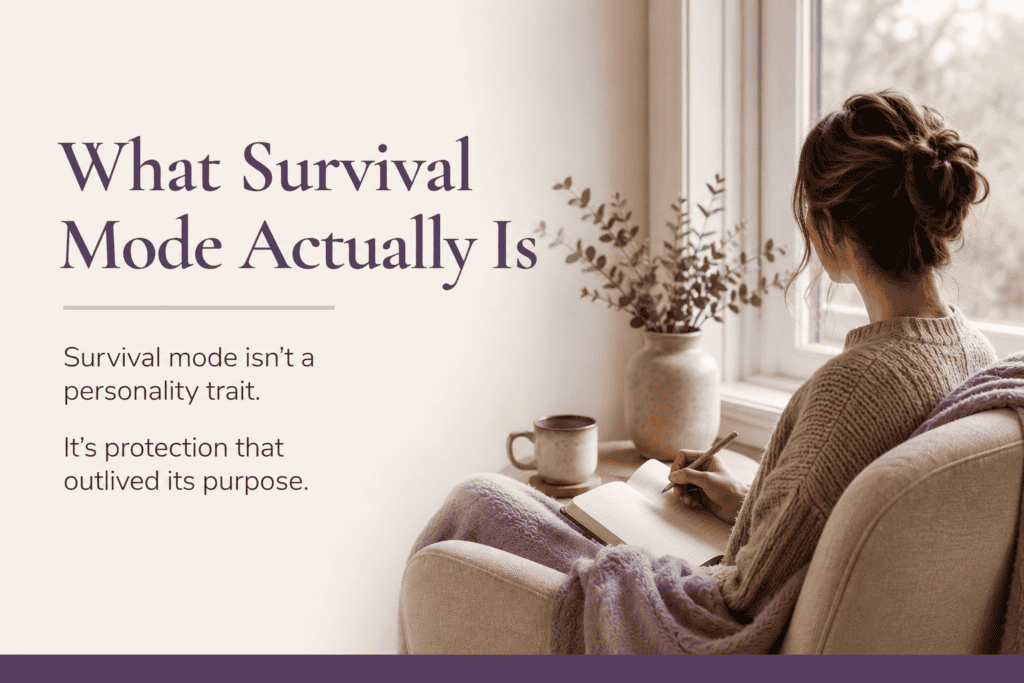
What Survival Mode Actually Is
A lot of people hear the phrase “survival mode” and think it only applies to major crises or traumatic events. They picture someone going through something extreme, constantly dealing with one emergency after another. While survival mode can absolutely show up during those situations, that’s not how most women in recovery experience it.
For many of us, survival mode looks normal from the outside. We go to work, take care of our families, pay the bills, show up for our responsibilities, and do everything we’re supposed to do. In some cases, life may actually look pretty good compared to where it once was. The challenge is that even when our circumstances begin to improve, our minds and bodies don’t always get the message right away.
The easiest way I can explain survival mode is this: it’s protection that outlived its purpose.
At some point, the habits you’re struggling with today may have actually helped you. Living with addiction, unhealthy relationships, constant stress, chaos, fear, uncertainty, or emotional pain teaches you how to survive. You learn to stay alert. You learn to expect problems. You learn to think three steps ahead and prepare for the worst just in case it happens. When life feels unpredictable, those habits can make sense.
The problem is that our minds don’t automatically switch those habits off just because life starts getting better.
Many women enter recovery expecting that once they get sober, they’ll finally feel calm, confident, and at peace. I know I thought that. What I didn’t understand was that while I had stopped using substances, I hadn’t stopped living like I was waiting for the next disaster. My circumstances were changing, but many of my thoughts, reactions, and coping mechanisms were still operating from the same place they always had.
Looking back, I can see that I spent so many years focused on surviving that I didn’t really know how to do anything else. I didn’t know how to relax without feeling guilty. I didn’t know how to trust that things would be okay. I didn’t know how to sit in a peaceful moment without wondering how long it would last.
That’s what survival mode often feels like.
It’s constantly scanning for problems before they happen. It’s assuming the worst when you don’t have all the information. It’s feeling responsible for everything and everyone around you. It’s being exhausted but struggling to rest. It’s reaching a point where being busy feels normal and slowing down feels uncomfortable.
The important thing to understand is that survival mode doesn’t mean you’re broken. It doesn’t mean you’re weak, failing, or doing recovery wrong. In many ways, survival mode is proof of how adaptable and resilient you are. Your mind found ways to get you through some incredibly difficult seasons of your life.
The issue isn’t that those survival strategies existed. The issue is that many of them are still running in the background long after they’ve stopped being helpful.
What once protected you can eventually start keeping you stuck.
That’s why so many women in recovery feel frustrated with themselves. They know they’ve changed. Their life may be more stable than it used to be. They’ve worked hard to get where they are. Yet they still feel anxious, exhausted, overwhelmed, or disconnected from themselves.
If that’s where you are right now, I want you to hear this: there is nothing wrong with you.
You may simply be carrying survival habits that have been with you for so long that they’ve started to feel like part of your personality. The good news is that they aren’t your personality. They’re patterns. And patterns can be changed.
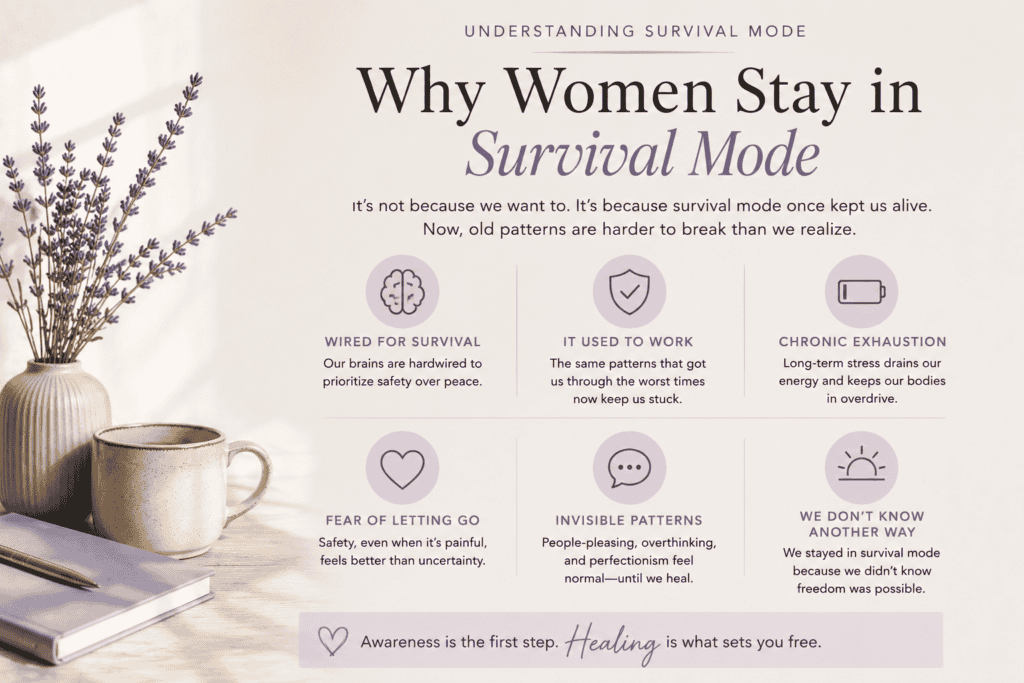
Why Women in Recovery Often Stay in Survival Mode
One of the biggest misunderstandings about recovery is believing that getting sober automatically solves everything else.
Don’t get me wrong, getting sober is a huge accomplishment. For many of us, it’s one of the hardest things we will ever do. It takes courage, commitment, and a willingness to face things we spent years trying to avoid. But while sobriety is an incredible milestone, it isn’t the end of the work. In many ways, it’s the beginning.
What I have learned, both from my own experience and from talking to other women in recovery, is that addiction is often only one piece of the puzzle. When the substances are removed, we’re still left with everything underneath them. The fears, the pain, the unhealthy coping mechanisms, the shame, the people-pleasing, the self-doubt, and the patterns we’ve carried for years don’t simply disappear because we got sober.
That’s why so many women find themselves confused in recovery. They expected to feel better, but instead they still feel anxious, exhausted, overwhelmed, or stuck. They start wondering what’s wrong with them because life is improving, but they don’t feel the way they thought they would.
The truth is that many of us aren’t just recovering from addiction. We’re recovering from years of living in survival mode.
For a long time, chaos may have been normal. When your life has been filled with uncertainty, unhealthy relationships, financial struggles, legal problems, family conflict, substance use, or simply trying to make it through one day at a time, your mind learns to function in that environment. You become good at managing crises because crises are familiar.
The strange thing is that when chaos becomes familiar, peace can feel uncomfortable.
Most people assume everyone wants peace, and of course we do. We say we want less stress, more stability, and a calmer life. But when you’ve spent years operating in chaos, peace can feel unfamiliar. And unfamiliar can feel unsafe.
I remember thinking that once life settled down, I would finally be able to relax. Instead, I found myself waiting for the next problem. If things were going well, I would wonder how long it would last. If there wasn’t a crisis to deal with, my mind would create one. Looking back, I can see that I wasn’t addicted to chaos, but I was used to it. My mind knew how to function in chaos. It didn’t yet know how to function in peace.
I see this happen all the time. A woman works hard to rebuild her life. She gets sober. She starts making healthier choices. Her relationships improve. She becomes more stable financially and emotionally. On paper, things look better than they have in years. Yet she still feels restless, anxious, and unable to fully enjoy what she has created.
The problem isn’t that she’s doing recovery wrong.
The problem is that her mind and body are still operating from old survival patterns.
When you’ve spent years preparing for the worst, expecting disappointment, or constantly trying to stay one step ahead of disaster, it takes time to learn a different way of living. Recovery isn’t just about putting down substances. It’s also about teaching yourself that you don’t have to live on high alert anymore.
That doesn’t happen overnight.
It’s a process of slowly learning that not every situation is a threat. Not every mistake is a disaster. Not every quiet moment means something bad is about to happen. Little by little, you begin teaching yourself that safety, peace, and stability are things you can experience without waiting for them to be taken away.
That’s why I believe recovery is about so much more than sobriety. Sobriety gives us the opportunity to build a different life, but healing is what helps us actually live it.
And that healing begins when we recognize that survival mode may have helped us get through the past, but it doesn’t have to control our future.
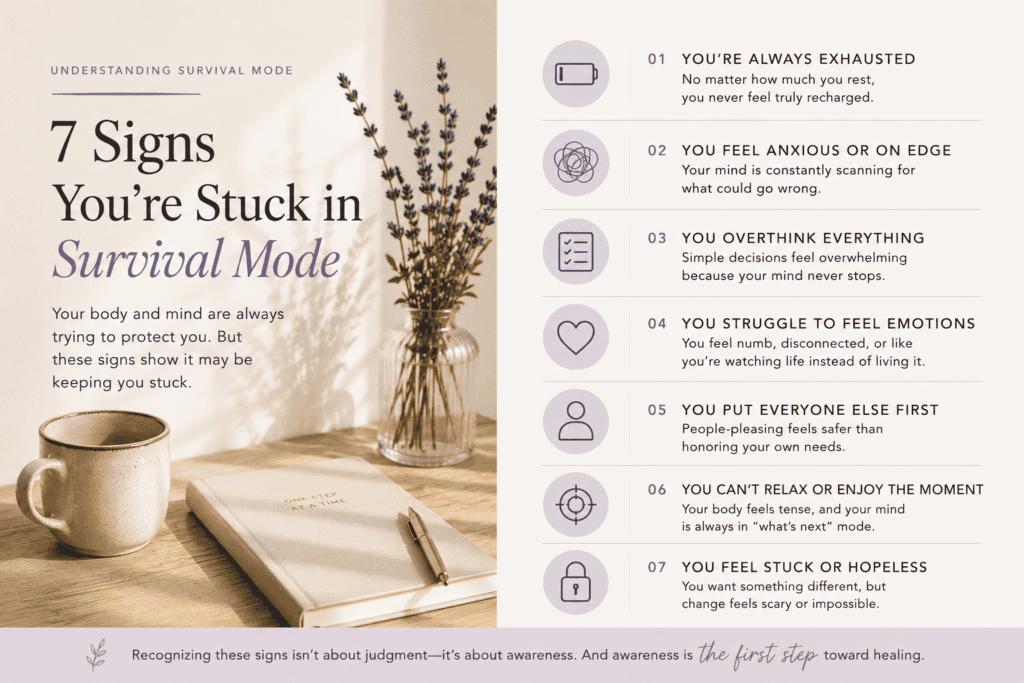
7 Signs You May Be Living in Survival Mode
One of the reasons survival mode can be so difficult to recognize is because many of the signs feel normal. They become part of your daily life, and after a while you stop questioning them. You assume that’s just how you are.
I can’t tell you how many times I’ve heard women describe these patterns as personality traits when they’re actually signs that their mind and body are still operating from a place of protection.
As you read through these, don’t worry about whether every single one applies to you. Just notice what resonates.
1. You’re Always Waiting for Something Bad to Happen
Even when life is going well, you have a hard time fully enjoying it. A part of you is always looking for the catch. You find yourself wondering when the next problem is going to show up or what could go wrong next.
Instead of feeling grateful for the peace, you spend your energy preparing for the possibility that it won’t last. It’s exhausting because you’re carrying stress even when there isn’t an actual crisis happening.
2. You Have Trouble Relaxing
You finally have some free time, but instead of enjoying it, you feel restless. You sit down to rest and immediately start thinking about everything you should be doing instead.
Many women in survival mode don’t know how to relax because their minds have been trained to stay alert. When you’re used to constantly solving problems, slowing down can feel uncomfortable, even when it’s exactly what you need.
3. You Feel Guilty When You Rest
Rest sounds good in theory, but when you actually try to do it, the guilt kicks in. There’s always one more thing that needs to be done, one more responsibility to handle, or one more person who needs something from you.
Somewhere along the way, many of us started believing that our worth was tied to our productivity. If we’re not doing something useful, we feel like we’re wasting time. That mindset can make it incredibly difficult to give ourselves permission to rest.
4. You’re Constantly Busy
Your schedule stays full. If you cross one thing off your list, you immediately find something else to replace it. Being busy has become your normal.
The problem is that busyness can sometimes keep us from noticing what’s going on underneath the surface. When every moment is filled with activity, there isn’t much room left for reflection, healing, or simply being present in our own lives.
5. You’re Emotionally Exhausted
This kind of exhaustion goes beyond being physically tired. It’s the feeling of carrying the weight of everything all the time. Even when nothing major is happening, you feel drained.
Many women in recovery think they should have more energy by now. Instead, they find themselves running on empty because their minds are still working overtime, constantly scanning for problems, managing stress, and trying to stay in control.
6. You Overthink Everything
You replay conversations after they’re over. You analyze decisions from every possible angle. You spend so much time thinking about what could happen that it becomes difficult to focus on what’s actually happening.
Overthinking often feels productive because it creates the illusion that we’re preparing for every outcome. In reality, it usually leaves us feeling more anxious, more overwhelmed, and less confident in ourselves.
7. You Struggle to Trust Yourself
You second-guess your decisions. You look to other people for reassurance before making choices. You worry about making mistakes and question whether you’re doing things the right way.
For many women, trust was damaged long before recovery began. Rebuilding that relationship with yourself takes time, and it’s difficult to move forward when every decision feels like a test you’re afraid of failing.
If you saw yourself in several of these signs, I want you to know that you’re not alone. More importantly, I want you to know that these patterns don’t mean you’re broken. They don’t mean you’ve failed at recovery, and they don’t mean you’ll always feel this way.
They may simply be signs that you’ve spent a long time surviving.
The good news is that once you recognize survival mode, you can begin doing the work of moving beyond it.
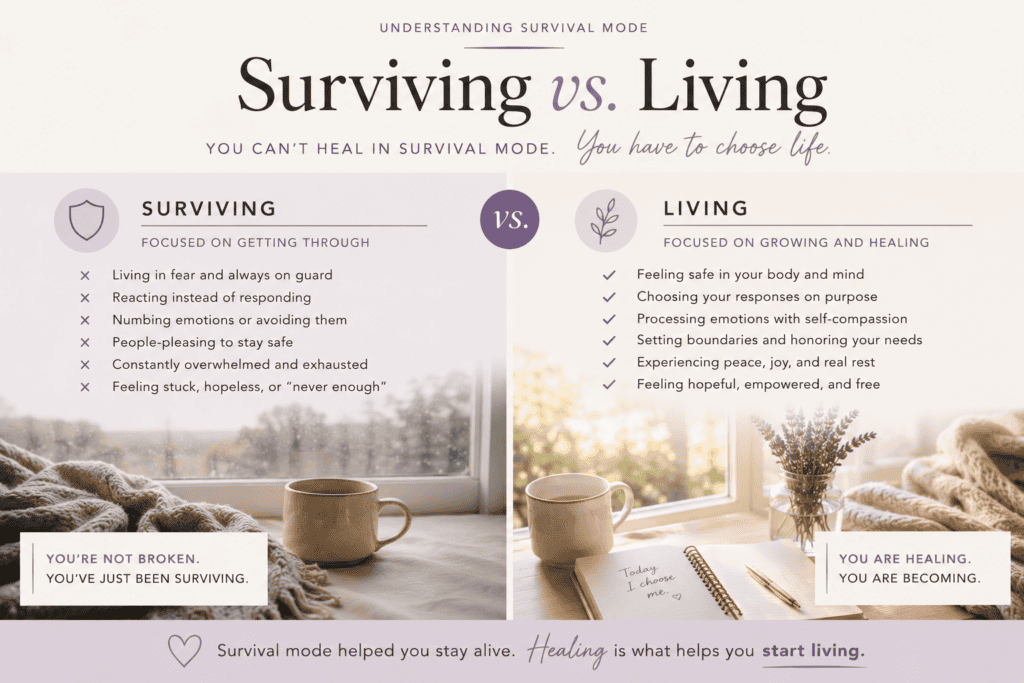
The Difference Between Surviving and Living
One of the hardest things about survival mode is that after a while, it starts to feel normal.
You get so used to operating a certain way that you stop questioning it. You assume everyone feels this stressed, this exhausted, this overwhelmed, or this disconnected. You tell yourself that life is hard and this is simply what adulthood looks like.
For a long time, I thought that was true too.
I thought being constantly worried was responsible. I thought staying busy meant I was productive. I thought always preparing for the worst was just being realistic. Looking back, I can see that I wasn’t really living my life. I was managing it. I was getting through it. I was doing everything I could to avoid things falling apart.
That’s what surviving often looks like.
When you’re surviving, most of your energy goes toward getting through the day. You’re focused on solving problems, preventing problems, or preparing for problems. Even during good seasons, part of your attention is spent waiting for the next challenge to show up.
There’s very little room left for joy, creativity, connection, or peace because so much energy is being used just trying to stay safe.
Living is different.
Living doesn’t mean life is perfect. It doesn’t mean you never have bad days, difficult emotions, or unexpected challenges. It simply means you’re no longer spending every day bracing for impact.
When you’re living instead of surviving, you begin to trust that you can handle what comes your way. You stop feeling responsible for controlling every possible outcome. You start allowing yourself to enjoy the good moments instead of worrying about how long they’ll last.
You become more present.
You notice the little things.
You laugh more.
You rest without feeling like you have to earn it.
You make decisions based on what you want instead of what you’re afraid of.
Most importantly, you begin participating in your life instead of just getting through it.
I think that’s something many women in recovery don’t realize they’re missing. They work incredibly hard to get sober, rebuild relationships, and create stability, but they never stop to ask themselves if they’re actually enjoying the life they’re working so hard to build.
That’s not a criticism. It’s something many of us were never taught.
When you’ve spent years in survival mode, learning how to live can feel unfamiliar. It takes practice. It takes patience. It takes a willingness to believe that there is more available to you than simply making it through another day.
The good news is that living isn’t something you’re born knowing how to do. It’s something you can learn.
And it starts with recognizing that surviving got you here, but it doesn’t have to be where your story ends.
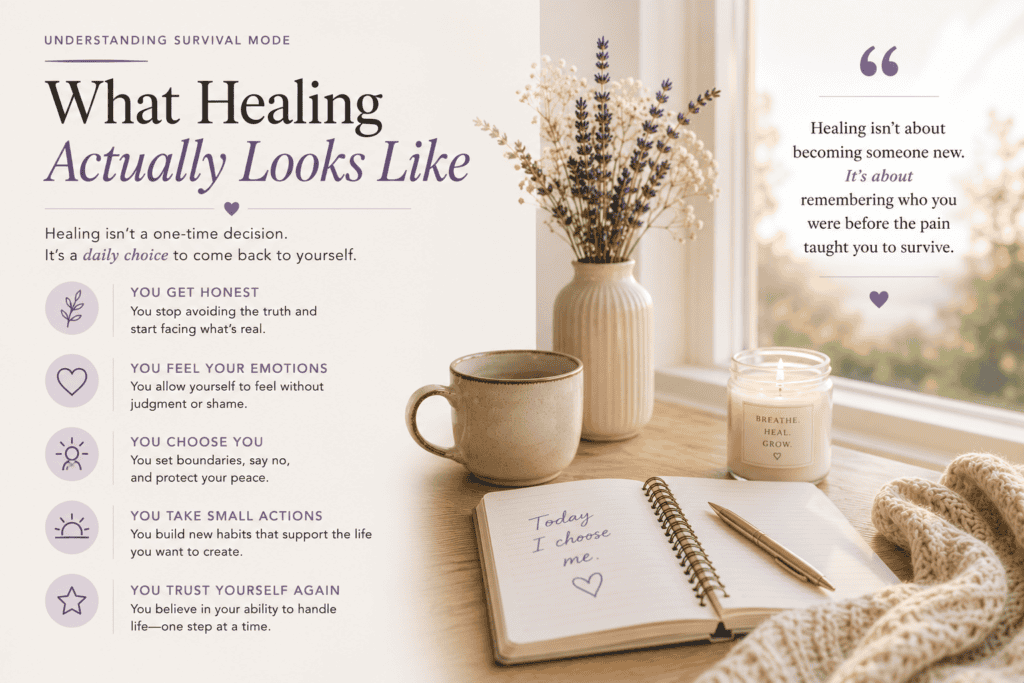
What Healing Actually Looks Like
One of the reasons so many women become frustrated in recovery is because healing rarely looks the way we expect it to.
Most of us want a breakthrough moment. We want the day we finally figure it all out. We want to wake up feeling confident, peaceful, and completely free from the things we’ve struggled with for years.
While those moments can happen, that’s usually not how healing unfolds. More often, healing looks small.
It looks like becoming aware of patterns you never noticed before. It looks like catching yourself when you’re expecting the worst and asking, “Is there actually a problem right now, or am I preparing for one that hasn’t happened?” It looks like recognizing when you’re running on autopilot and beginning to question whether those habits are still serving you.
Awareness may not seem exciting, but it’s where change begins.
You can’t change what you don’t recognize. Once you start noticing survival mode in your daily life, you create an opportunity to respond differently. Maybe not every time. Maybe not perfectly. But little by little, you begin making choices instead of reacting out of old habits.
Healing also happens through small steps.
I think a lot of women get discouraged because they’re looking for huge changes while overlooking the small victories happening every day. Choosing to rest when you normally push through. Saying no when you usually say yes. Asking for help instead of trying to carry everything yourself. Taking a few minutes to check in with yourself before immediately focusing on everyone else.
Those things may seem insignificant, but they’re not. Small steps are often what create lasting change because they teach you how to live differently in real life, not just in theory.
Another part of healing that doesn’t get talked about enough is self-compassion.
Many women are carrying an incredible amount of guilt, shame, regret, and self-judgment. They speak to themselves in ways they would never speak to someone they love. They expect themselves to heal quickly, never make mistakes, and somehow know exactly what they’re doing every step of the way.
That’s a lot to ask of anyone.
Healing doesn’t require perfection. It requires honesty. It requires accountability. It requires a willingness to keep moving forward even when progress feels slow. Beating yourself up every time you struggle doesn’t make healing happen faster. It usually makes the process harder.
One of the biggest lessons I’ve learned is that healing is not about becoming a different person. It’s about learning how to feel safe being yourself.
For many women in recovery, safety is something they have very little experience with. Not physical safety necessarily, but emotional safety. The feeling that you can make a mistake without everything falling apart. The feeling that you can rest without guilt. The feeling that you don’t have to constantly prove your worth, earn your place, or stay on high alert to deserve peace.
Learning safety takes time.
It happens through repeated experiences that show your mind and body that life is different now. It happens when you keep promises to yourself. It happens when you create healthy boundaries. It happens when you choose people, environments, and habits that support the life you’re trying to build.
Most importantly, it happens one day at a time.
If you’re reading this and realizing you’ve been living in survival mode, I don’t want you to walk away thinking you need to fix everything immediately. You don’t.
You don’t need to have all the answers today.
You don’t need a perfect plan.
You don’t need to heal every wound before you’re allowed to move forward.
You simply need to become aware of where you are, offer yourself some grace, and take the next step that’s in front of you. That’s how healing begins. Not through giant leaps.
Through small, consistent choices that gradually teach you there is more to life than simply surviving.
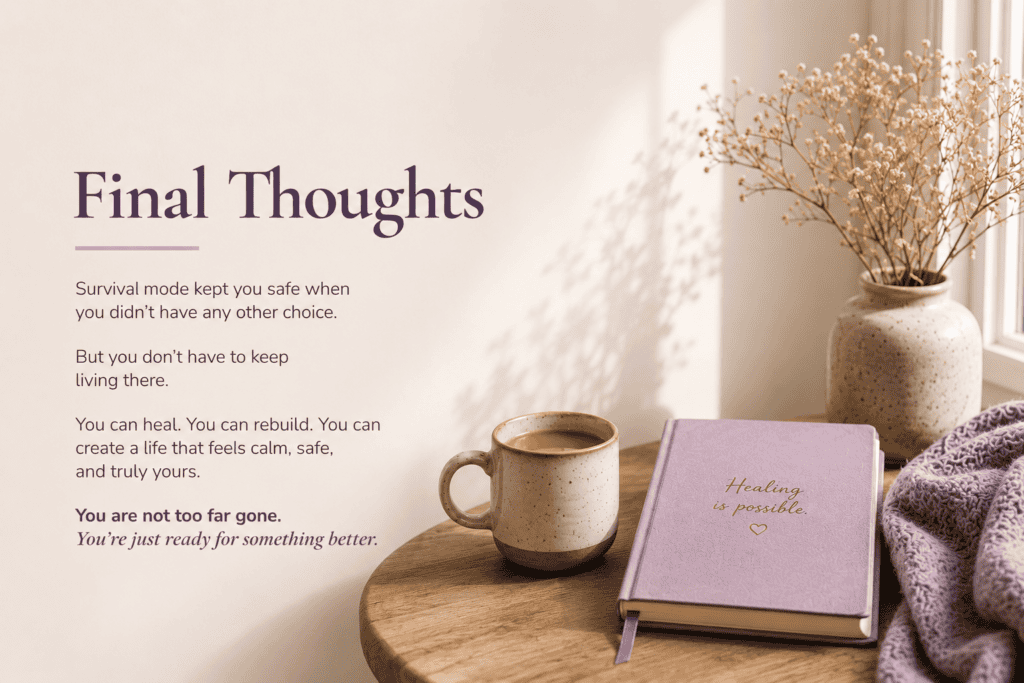
Final Thoughts
If you’ve read this article and found yourself nodding along, I want you to know something:
You are not broken.
You are not failing at recovery.
You are not weak because you’re still struggling with anxiety, exhaustion, overthinking, or the feeling that you can never fully relax.
Many women spend years learning how to survive difficult circumstances. We learn to stay alert, expect problems, put everyone else’s needs ahead of our own, and keep going no matter how tired we are. Those habits don’t disappear overnight just because life begins to change.
Recovery is about so much more than putting down substances.
It’s about learning how to trust yourself again.
It’s about creating safety within yourself.
It’s about healing the parts of you that have been carrying the weight of survival for far too long.
Most importantly, it’s about learning that you deserve more than a life spent simply getting through the day.
If you recognized yourself in some of the signs we talked about, don’t let that discourage you. Let it bring awareness. Awareness is where healing begins. Once you can recognize the patterns, you can start making different choices. Not all at once. Not perfectly. Just one step at a time.
The woman you are becoming doesn’t need to have everything figured out.
She doesn’t need to be perfect.
She doesn’t need to heal overnight.
She simply needs to keep showing up for herself, one day at a time, and trust that every small step forward matters.
Because surviving got you here.
Now it’s time to learn how to live.
Ready to Take a Small Step Forward?
If you’ve recognized yourself in this article, I want to encourage you to keep it simple.
You don’t need to overhaul your entire life this week.
You don’t need a perfect recovery plan.
You don’t need to have everything figured out.
Sometimes healing begins with five intentional minutes.
That’s why I created My Authentic Morning Ritual Planner—a simple guide designed to help women in recovery reconnect with themselves before the demands of the day take over. It’s not about perfection or adding more to your to-do list. It’s about creating a few quiet moments to check in with yourself, your intentions, and your Higher Power.
If you’re ready to begin moving out of survival mode and into a more intentional way of living, download your free copy and start with one small step tomorrow morning.
Because healing doesn’t happen all at once.
It happens one choice, one day, and one moment at a time.

0 Comments